Excerpt from: Bromage, Michael (2026, p158). Designing Favourable Conditions for Social Inclusion and Community Innovation in a Regional City. PhD by Publication, Queensland University of Technology. https://doi.org/10.5204/thesis.eprints.265362
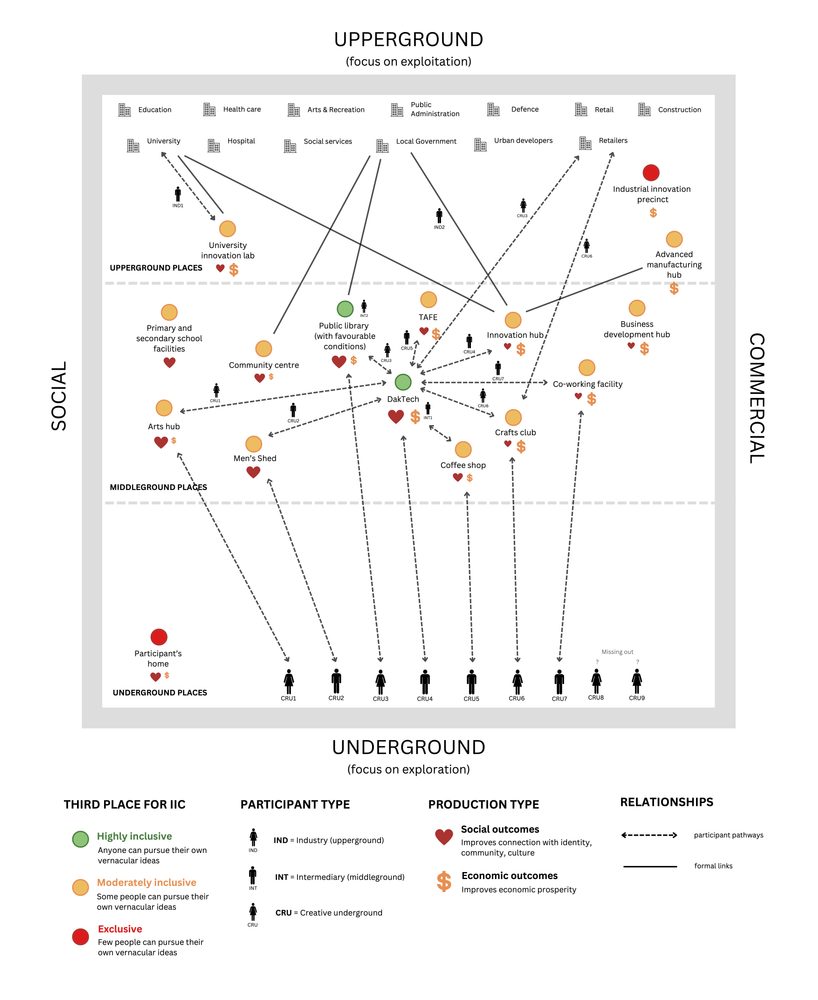
Figure 31.
5.1.1 The anatomy of a creative city
This thesis reframes Cohendet et al.’s (2010) anatomy of the creative city as a conditions assemblage, in which inclusive innovation emerges when the middleground operates as civic infrastructure that is psychosocially safe, institutionally legitimised, and flexibly stewarded. This reframing shifts emphasis away from linear pipelines in which creative outputs move from the underground to the upperground for exploitation, toward circulation across layers enabled by favourable relational and institutional conditions. In this context, the three layers are understood as interdependent rather than hierarchical: each must be deliberately considered, held in balance, and supported if an Inclusive Innovation Community (IIC) is to be activated and sustained in a regional city.
Synthesised in this way, the anatomy of the creative city reveals that inclusive innovation does not arise from any single layer, nor from the linear translation of underground creativity into upperground productivity. Innovation emerges when conditions enable ideas, people, resources, and reputational capital to circulate through a well‑supported middleground. The analysis presented in Chapter 4 demonstrated that when such conditions were absent – where the middleground collapsed, became overly institutionalised, or subsumed by the upperground – innovation potential fragmented, participation narrowed, and inclusive social and innovation outcomes diminished. These findings position the middleground as essential civic infrastructure – an innovation commons – whose presence or absence shapes the capacity for inclusive innovation.
Viewed in this way, the multi-layered creative city operates as both a diagnostic and design framework. It enables identification of where conditions support inclusive innovation, where they constrain it, and where deliberate intervention is required. Importantly, the innovation commons is dynamic and perpetually changing – more akin to a cultivated ecosystem (think of a wilding garden) than a fixed system – and its continuation depends on sustained facilitation, trust‑building, and the ongoing translation of expectations, capabilities, and values across layers, sectors, participants, and organisations. Within this framing, inclusive third places are understood as spatial manifestations of a middleground innovation commons. Drawing on McQueenie et al.’s distinction between social and economic value (adapted from Teli; McQueenie et al., 2024a, p. 104), my thesis foregrounds social, relational, and civic value alongside dominant commercial innovation preferences (Figure 31). The empirical findings indicate that regional cities already possess sufficient places and infrastructure to support IICs; what varied was the capacity to reconfigure them through relational intermediation, a role for design intermediaries.