Below is a summary of my PhD research topic.
Designing Favourable Conditions for Social Inclusion and Community Innovation in a Regional City
Many people in regional cities have limited opportunities to create or innovate, particularly those from disadvantaged and marginalised groups who are excluded from mainstream innovation ecosystems. Employing reflective, participatory, and design-led research across public and commercial settings, this applied PhD created and tested favourable conditions that enabled an inclusive innovation community to emerge and flourish in the regional city of Townsville. Outcomes included new community-led initiatives responding to local needs, and reduced experiences of loneliness and social isolation. The findings offer clear guidance for policymakers and practitioners seeking to expand regional innovation while also improving social and digital inclusion outcomes.
Unlocking hidden creativity in regional communities
Many people living in regional cities have ideas, talents, and creative energy, but few opportunities or places to use them. At the same time, loneliness and social isolation are growing problems, especially for people who are marginalised, under‑resourced, or excluded from mainstream innovation and prosperity pathways. My research shows that these two problems can be addressed together.
What I studied
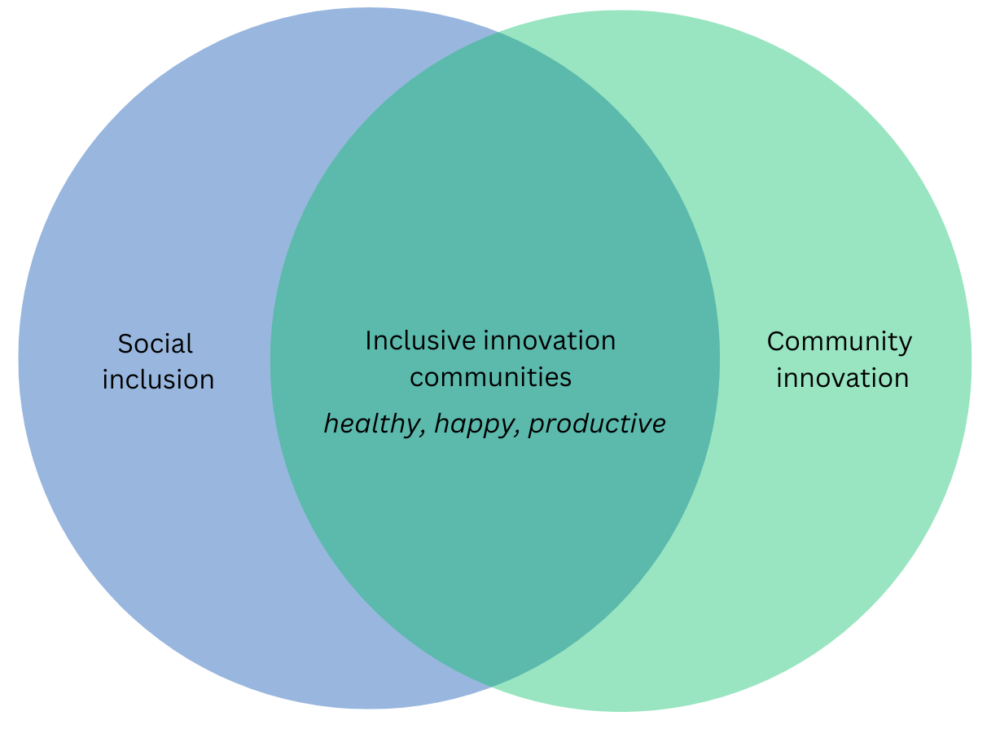
I studied how inclusive innovation communities can be created in a regional city (Townsville, North Queensland). These are welcoming, low‑barrier community spaces where everyday people, including marginalised and underserved groups, artists, carers, young people, parents, makers, hobbyists, and others, come together to explore ideas, make things, learn from each other, build social connections, and produce meaningful outcomes for themselves and their communities.
Rather than focusing on start‑ups or high‑tech entrepreneurship, my research focused on the creative underground – people whose vernacular creativity is often overlooked, but who bring deep lived experience and valuable ideas beneficial for themselves and their communities.
What I did
Using hands‑on, design‑led research, I worked with communities, businesses, governments, and universities to create and study these spaces. This included:
- Adapting everyday places into creative, welcoming third places (in public- and commercial settings)
- Supporting people to pursue their own vernacular ideas, at their own pace
- Measuring creative practice outcomes and changes in wellbeing, including loneliness and social isolation, and innovation (creating new value)
- Working with participants and policymakers to translate lived experience into practical policy advice.
What I found
Across multiple projects, four things consistently mattered:
- Inclusive places
Safe, welcoming multi-layered, cross-sectoral third places and spaces – outside home and work – where people can casually meet, create, and belong. - Design intermediaries
Skilled practitioners who connect people, organisations, and resources and help ideas progress. - Small, flexible resources
Micro‑funding, industry quality shared resources, and access to facilities make it much easier for people to get started and collaborate. - Supportive culture and stories
Communities thrive when everyday creativity is valued and celebrated, developing confidence, and expanding the narrow mainstream version of ‘innovation’.
These four elements must be cultivated and sustained over time.
Why it matters
The research showed measurable reductions in loneliness, alongside increased confidence, skills, and community contribution. People felt confident, started programs, built prototypes, created social enterprises, and helped others.
Socially, this approach:
- Reduces isolation and improves wellbeing
- Builds trust across diverse groups
- Gives more people a say in shaping their future and their community’s future.
Economically, this approach:
- Unlocks under‑utilised local talent
- Connects the resources of the upperground with the ideas of the underground through a middleground innovation commons
- Builds skills and capability from the ground up
- Strengthens regional resilience utilising existing infrastructure.
The big idea
Inclusive innovation needs more than flashy programs, short‑term projects, and targeted investment; it comes from the perpetual co-design of favourable conditions – cultivating places, people, resources, and culture – so communities can innovate continuously.
This research provides a practical, proven playbook for councils, organisations, businesses, and employers who want stronger, more creative, resilient, innovative, and more connected regions.
Selected publications
- Bromage, Michael (2026) Designing Favourable Conditions for Social Inclusion and Community Innovation in a Regional City. PhD by Publication, Queensland University of Technology. https://doi.org/10.5204/thesis.eprints.265362
- Bromage, M., Foth, M., Hearn, G., & Osman, K. (2024). Creative spaces in public libraries: Navigating the culture clash with institutional norms and expectations. Journal of Library Administration, 65(1), 31–57. https://doi.org/10.1080/01930826.2024.2412189
- Bromage, M., Foth, M., Osman, K., & Hearn, G. (2025). From innovation theatre to systemic change: The role of intermediaries in design thinking. Design Studies, 101(101360), 101360. https://doi.org/10.1016/j.destud.2025.101360
- Bromage, M., Foth, M., Osman, K., & Hearn, G. (2025). Activating Townsville’s Creative Underground. Queensland University of Technology, Brisbane, Australia. ISBN: 978-1-925553-57-4. https://doi.org/10.5204/book.eprints.254916
Acknowledgements
The research was supervised by Professor Marcus Foth, Professor Greg Hearn, and Dr Kim Osman.
The research was supported by the Commonwealth through an Australian Government Research Training Program Scholarship (DOI: https://doi.org/10.82133/C42F-K220).
The research was supported by a QUT Postgraduate Research Awards (QUTPRA) scholarship funding from Queensland University of Technology.
This research contributes knowledge to the Digital Media Research Centre’s ARC Linkage project Advancing digital inclusion in low‑income Australian families (LP190100677).
The research contributes to social innovation supported by the Queensland Government Department of Treaty, Aboriginal and Torres Strait Islander Partnerships, Communities and the Arts, through the Communities Innovation Fund – Small Grants 2022–23, addressing social isolation and loneliness.
The research respectfully acknowledges the Wulgurukaba of Gurambilbarra and Yunbenun, Bindal, Gugu Badhun, and Nywaigi peoples as the Traditional Owners of the lands on which this research was conducted and pay my respect to Elders past and present. I also acknowledge the Turrbal and Yugara peoples as the First Nations custodians of the lands on which QUT stands, and recognise these lands as places of teaching, learning, and research, and the ongoing role of Aboriginal and Torres Strait Islander peoples within the QUT community.